


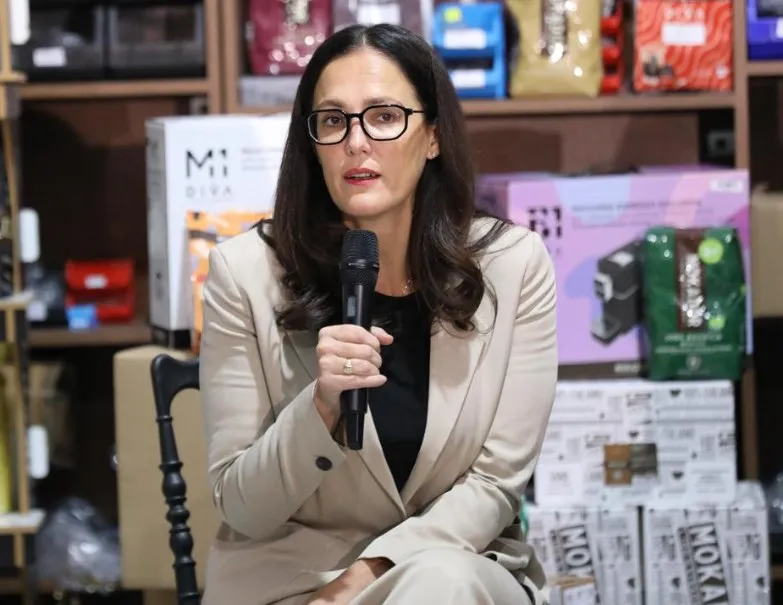
The Minister of Economy and Innovation, Delina Ibrahimaj, said today that the government aims to mediate the employment of around 10,000 young people during 2027 through the Youth Guarantee Program, which foresees a total fund of about 60 million euros.
During an interview with Euronews Albania, when asked about the protests that have taken place in the country in recent days, Ibrahimaj stated that the program, developed in cooperation with the European Union, aims to offer young people up to the age of 29 employment and professional training opportunities.
According to the minister, the program was piloted in 2026 and is expected to begin implementation nationwide in 2027.
“We need to sit down for dialogue with them in order to build programs intended for young men and women. We are certainly implementing a very large program called the Youth Guarantee Program, a program built in cooperation with the European Union, a program that foresees a total fund of nearly 60 million euros, dedicated precisely to employment and providing employment opportunities or professional training for every young man and woman up to the age of 29. These are programs that have worked in many other European countries, or countries that have been candidate countries and joined the European Union and have proven successful.
It is a program that was piloted in 2026 and will begin implementation nationwide in 2027. These are programs we have planned for in advance, worked on together with European Union experts, and we will start large-scale implementation in 2027 and are included in the 2027 budget. We plan to mediate youth employment, providing employment for nearly 10,000 young people by 2027. These are not low numbers, and the labor market is a very dynamic one; it is a market that requires qualified human resources. Students are precisely the target group most demanded by the labor market, and certainly we are here to do our duty,” she said.
Ibrahimaj said, “We will sit down with the students to specifically discuss all the programs we have. I am convinced that there is also some level of misinformation regarding the programs we currently have in place, and without a doubt, after a dialogue with the students, we will be able to address the issues they raise.”
She stated that some of the demands presented so far are general, unlike those of the 2018 protests.
“Currently, the demands we have heard in recent days are very broadly expressed, unlike the demands students had in 2018 when they came with concrete proposals to solve their problems in daily life,” said Ibrahimaj.
Ibrahimaj announced that the Council of Ministers has approved amendments to the housing law, which foresee expanding support beyond social programs, including affordable housing for the middle class.
According to Ibrahimaj, by the end of November or the beginning of December, depending on the approval of the draft law by the Assembly, it is expected that 3,000 apartments will be made available with 50% subsidized rentals, 2,000 apartments through zero-interest loans, and another 2,000 apartments with 3% subsidized loans.
“A new policy, very important for costs and coping with living expenses, is also the new housing policy, for which today we passed the law in government, the amendments to the new law, the housing law, which takes into account support not only for social housing programs but also for affordable housing programs dedicated to the middle class, students, young professionals, and young families.
“We will make available, starting from the end of November or the beginning of December, depending on when the parliament approves the draft law we approved today in the Council of Ministers, a total of 3,000 apartments where rent will be subsidized half-by-half, dedicated precisely to young people; 2,000 apartments with zero-interest loans, also dedicated to young professionals; and also 2,000 apartments with subsidized loans at 3% interest,” she said.
According to the minister, these schemes aim to support students, young professionals, couples, and young families in securing their first home by reducing rent costs and financing costs through loans.
“These are policies that we have seen, implemented, studied; these are policies implemented in all countries of the world and align with the policies we are undertaking to reduce the living costs of young families and young couples, with the aim of mediating the insurance of a first home, whether at low rent or low cost, by subsidizing loan interest rates, and the state taking responsibility to pay these interest rates,” said Ibrahimaj./ATSH
