


By Edvin Peçi
The freedom to protest, to raise one’s voice, and to demand a better life is a fundamental right that cannot and should not be negotiated. But this right cannot be turned into the freedom to destroy another’s property, endanger people’s lives, or paralyze a country’s economy. Because in the end, the price of violence is not paid only by the attacked businesses, but by society as a whole.
There is a boundary that even the greatest civic anger must not cross: the boundary between protest and violence, between the right to oppose and the violation of another’s right to live, work, and build their future.
Albanians have the right to be dissatisfied. They have the right to protest, to demand more from the government, to oppose economic policies, inequalities, injustices, or a reality that does not align with their aspirations for a better life. They have the right to do this loudly, strongly, with all the energy that stems from disappointment and hope for change.
But no one has the right to unleash this anger onto another person’s life, property, and work.
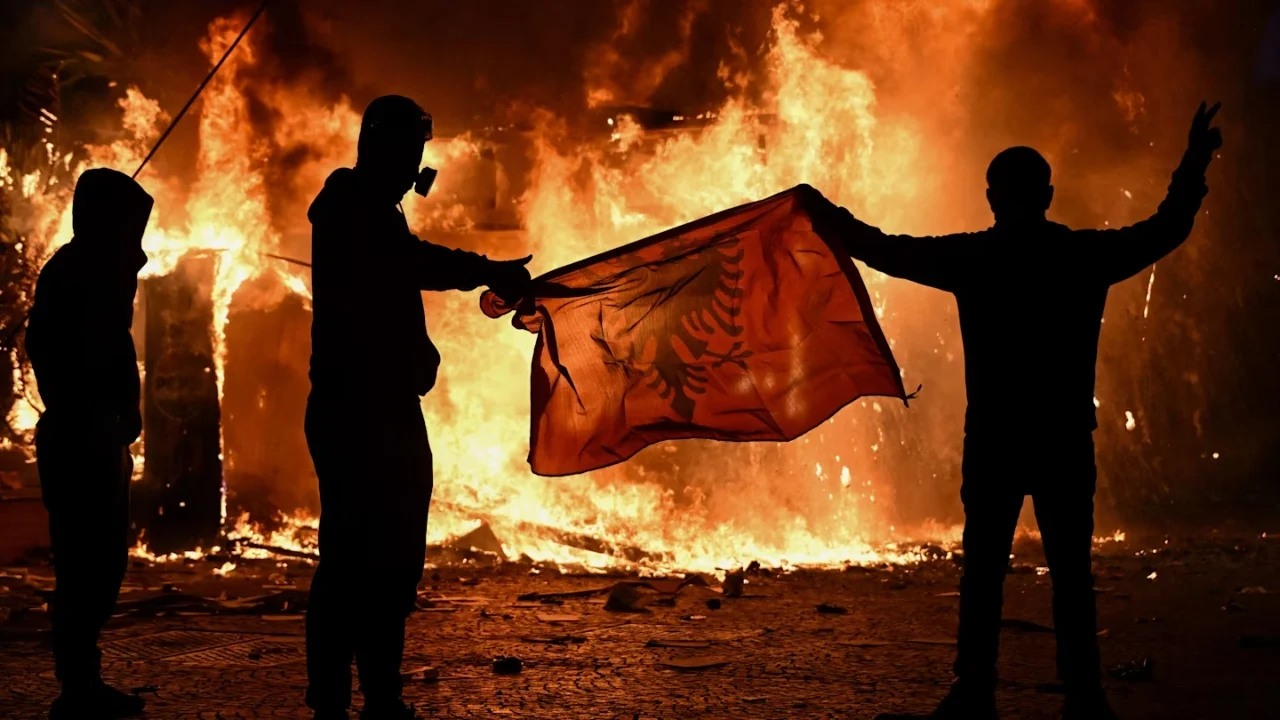
The events of the first days of the protests, where a range of businesses—from large companies to small enterprises, shops, and service offices—became targets of attacks, damage, and vandalism, should serve as a moment of reflection for everyone.
Because behind every broken window, behind every broken door, behind every damaged office or shop, there is not simply a commercial entity. There is an investment, a sacrifice, years of work, family savings, loans taken, risks taken, and, above all, people who make a living from that activity.
A business is not just private property. It is a job, the salary of a family, a contribution to the state budget, consumption, production, service, and added value for the economy.
When a business is destroyed, it is not only its owner that is affected. The employee who risks losing their salary, the supplier who loses a customer, the family that relies on that income, and finally, the economy itself, which should create prosperity for everyone, are also affected.
In a society where economic inequalities are evident and where a portion of citizens feel excluded from the fruits of economic growth, it is understandable that anger is also directed at those perceived as richer, more powerful, or more privileged.
Banks, financial institutions, telecommunications companies, and large businesses can be seen by some protesters as symbols of an economic system that has not offered equal opportunities to everyone.
But perception, no matter how strong, cannot be turned into a justification for violence.
Banks’ profits, interest rates, financial service fees, communication prices, or the practices of large companies can be criticized. More competition, transparency, social responsibility, and regulatory intervention can be demanded.
In fact, these are essential debates in an economy that aims to be fairer and more inclusive.
But the answer to these problems cannot be breaking into an ATM, burning a bank branch, destroying a service office, or damaging communication infrastructure.
Because these are not attacks against injustice. They are attacks against the mechanisms that keep economic and social life functioning.
In recent days, some banks have been forced to limit their physical activities, temporarily close branches, and direct customers towards digital channels due to the security situation.
These measures are understandable when it comes to protecting employees and customers. But at the same time, they are a worrying signal about the consequences that escalation of violence may bring.
The banking system is to the economy what blood circulation is to the human body.
Through it pass salaries, pensions, business payments, loans, investments, savings, and daily transactions.
If this circulation is interrupted, the consequences do not remain within the walls of a bank.
A business may fail to make payments to suppliers. A citizen may not have access to the services they need. A small business may face liquidity difficulties. An investment may be postponed and an economic activity may be suspended.
If the paralysis expands and persists, the effects can spread throughout the economy, disrupting its normal functioning. In the most extreme scenario, a severe and prolonged disruption of financial circulation can push economic activity toward a state that, figuratively, can be called clinical death.
And the paradox is that the greatest victims of such a situation would be precisely the citizens protesting for more welfare.
Equally essential is telecommunications infrastructure.
In a modern society, mobile companies do not simply offer phone calls or the internet. They provide a critical infrastructure on which daily communication, public services, financial transactions, businesses, and the functioning of institutions rely.
Damage to this infrastructure would not only affect the companies that own it.
It would affect citizens, families, businesses, emergency services, and the protesters themselves.
In a mass protest, communication is vital. It is the tool to coordinate movements, to report risks, to seek help, to document events, and to ensure that information circulates.
Security forces and emergency services also rely on communication to manage difficult situations and protect people’s lives.
Without communication, the risk of misinformation, panic, and loss of control increases significantly.
A widespread network outage would create a communication blackout, making an already tense situation even more dangerous.
Therefore, telecommunications infrastructure must remain free from any form of violence. It is not simply an asset of a private company, but a vital service for the entire society.
In this reality, the responsibility does not fall solely on the protesters.
The state and security institutions have a legal and constitutional obligation to simultaneously guarantee two rights: the right to protest peacefully and the right to live, work, and conduct economic activity in security.
These rights are not opposed to each other.
On the contrary, they are part of the same democratic order.
The police have the right and duty to intervene to prevent attacks on property, to protect employees, clients, and citizens, as well as to ensure the functioning of essential services.
But this obligation must always be exercised within the law, proportionally, without excessive use of force, and without treating peaceful protest as a threat.
Likewise, the organizers and participants of the protests have the responsibility to distance themselves from violence and not allow their cause to be identified with destruction.
A protest aimed at seeking justice cannot produce new injustices.
A move that demands greater economic security cannot destroy jobs.
A revolt aimed at a better life cannot endanger the lives and well-being of others.
Albania needs debate, criticism, accountability, and, when citizens deem it necessary, even strong protests.
But Albania equally needs investments, entrepreneurship, jobs, and functional economic institutions.
We cannot seek more welfare by destroying the resources that create it.
We cannot demand more employment by harming the businesses that employ people.
We cannot demand a stronger economy by paralyzing banks, financial services, and communication networks that keep it moving.
Of course, businesses are not above criticism nor above the law. They must be held accountable for their practices, respect consumers, employees, and obligations to society.
But responsibility is sought through institutions, the law, competition, and public debate, not through violence.
Furthermore, it should not be forgotten that most enterprises are not corporations with large capital and considerable financial reserves. They are small and medium-sized businesses, often built with extraordinary family sacrifices.
For a small entrepreneur, a destroyed store can mean the loss of lifetime savings. For a family, closing the workplace can mean losing their only source of income.
These are not side damages that can be justified in the name of a cause, no matter how legitimate it may be.
These are real human and economic costs.
In the end, protest should be an instrument to change reality, not to destroy it.
Its strength lies in the number of citizens, in its argument, in determination, and in the ability to demand accountability, not in the number of broken windows or damaged businesses.
A democratic society must be free enough to allow the harshest protest, but also responsible enough not to let it turn into violence against the innocent.
Because the right to protest is the foundation of democracy, but the right of another to live, work, and protect their property is just as sacred.
And if the anger for a better life ends up destroying the jobs, investments, and economic opportunities of others, then the protest risks striking precisely the future it claims to build.
