


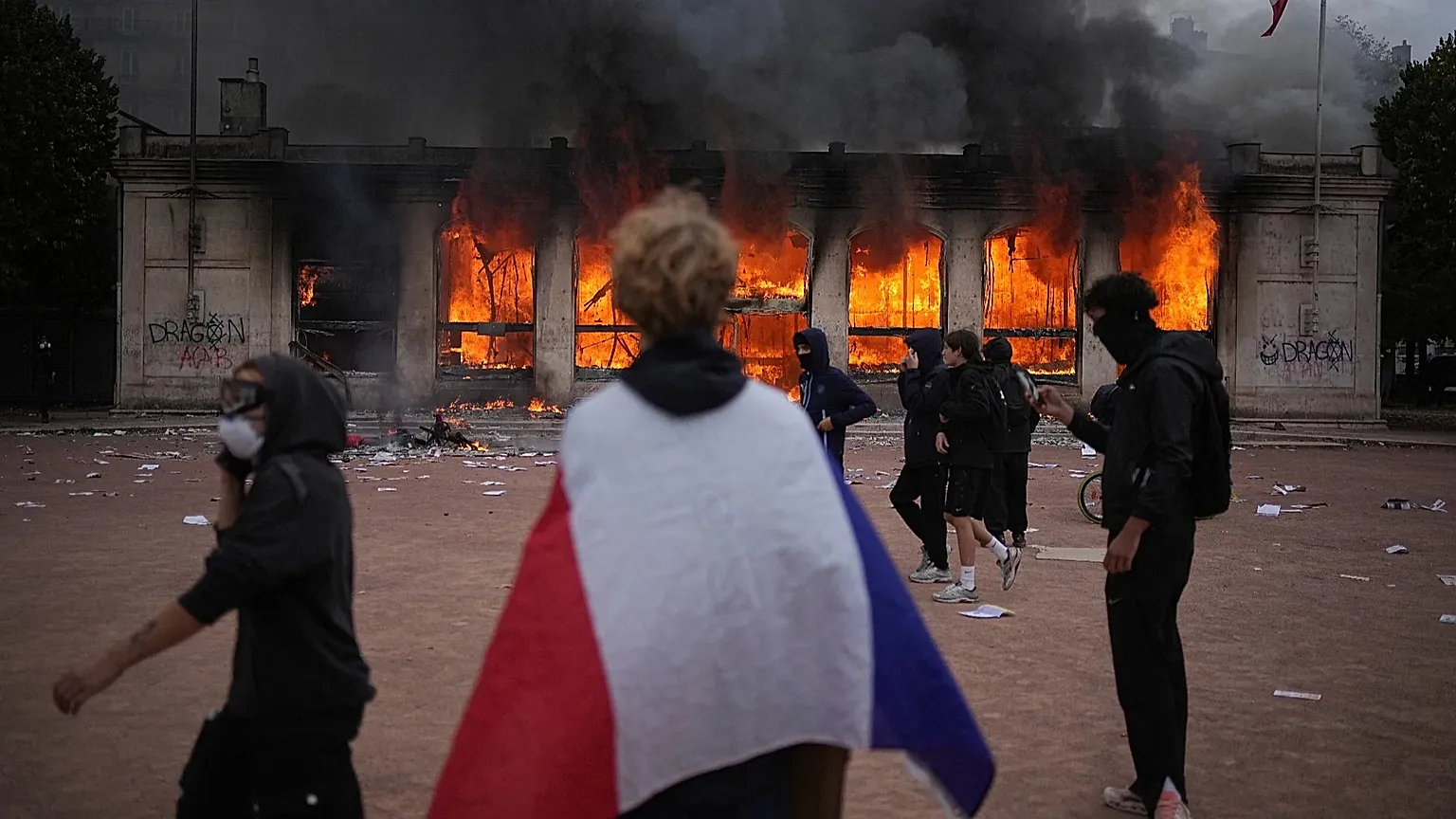
Stocks across Europe fell at the start of Monday’s trading, while France is facing one of the most violent weekends in recent years. Store owners and company executives are assessing the damage and accusing authorities of leaving them unprotected.
The Euro Stoxx 50 index recorded a decline of only 0.1%, while the broader pan-European index Stoxx 600 fell by over 0.6% at the start of Monday’s session.
In France, the CAC 40 index fell by 0.5%. For example, shares of the retail chain Carrefour, which announced that 50 of its stores were targeted by robbers, fell by more than 2%.
France’s borrowing costs also increased, while the divided parliament is discussing the budget for 2027. The yield on French government bonds with a 10-year maturity reached 4.86%, after reaching its highest level since 2002 earlier this month.
The difference with German bonds, an indicator of investor concern, reached 143.5 basis points. At the beginning of October, it had surpassed 150 basis points, marking the highest level since the euro debt crisis.
The credit rating agency Moody’s will review France’s Aa3 rating on Friday, which currently has a negative outlook.
As for other European indices, the UK’s FTSE 100, Italy’s FTSE MIB, and Spain’s IBEX 35 recorded declines ranging from 0.4% to 0.6% compared to Friday’s close.
The German DAX index led the declines, dropping by more than 0.8%, while the Netherlands’ AEX was an exception, with an increase of over 0.4%.
The euro fell by 0.2% against the US dollar, trading at around 1.121 dollars. It also lost 0.2% against the British pound, dropping to around 0.841 pounds.
Last week, the euro fell to its lowest level against the US dollar since mid-May 2025 and against the British pound since early June 2025. France’s debt problems and the strengthening of the US dollar are outweighing the impact of the two interest rate cuts carried out this year by the European Central Bank.
The next meeting of the European Central Bank is on October 29.
Authorities estimated that around 550,000 people participated in Saturday’s nationwide marches against the rising cost of living and the condition of French schools. The protests degenerated into riots and looting in Paris, Lyon, Marseille, Bordeaux, and other cities.
Interior Minister Laurent Nuñez said that 2,400 people were arrested, while the number of police, gendarmerie, and firefighters injured is reported to range from 500 to nearly 1,000.
Nuñez, who admitted that the authorities had not properly anticipated the events and that in some cities they had lost control, offered his resignation. However, President Emmanuel Macron rejected it, the president’s office announced on Monday, arguing that security forces needed uninterrupted leadership.
Carrefour’s CEO and head of the French Retail Trade Federation (FCD), Alexandre Bompard, said that around 1,500 stores were damaged, while the damage bill reached hundreds of millions of euros. He emphasized that the Republic must protect traders.
For Carrefour alone, “the cost of repairs will be significantly higher than 10 million euros,” Bompard stated.
Thierry Guibert, the executive director of the fashion brand Lacoste, whose stores, including those of Lacoste and Aigle, were looted, called on the French state through social media to act without delay to protect businesses and employees.
Thierry Cotillard, head of the Intermarché supermarket chain, also expressed his deep anger on social media. Meanwhile, Patrick Martin, head of the employers’ organization Medef, described the looting as unacceptable.
Owners of smaller businesses expressed themselves even more directly.
The head of the outdoor activity equipment sales company Snowleader said he had notified the police when the robbers were forcibly opening the door of his store in Lyon. However, according to him, the police asked him to wait and recontact the authorities on Tuesday if no one showed up.
Meanwhile, the head of the Marseille center traders’ association said that businesses had been abandoned by the authorities.
Meanwhile, the unions have called for a national strike on November 5. /Adapted from Euronews, ekofin.al
