


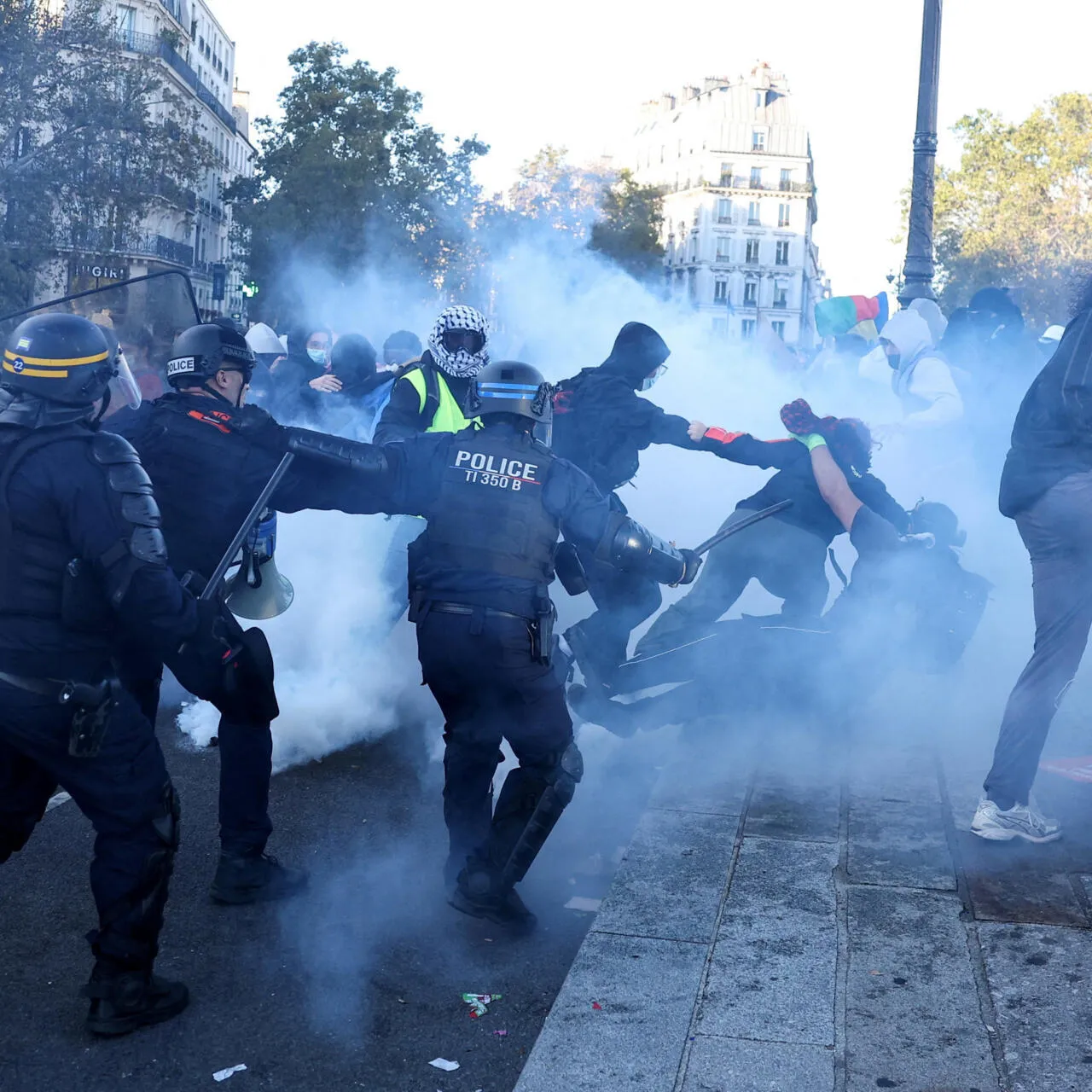
Police fired tear gas and clashed with protesters in several French cities on Saturday as thousands took to the streets to protest the high cost of living and the state of public services. The demonstrations were accompanied by some of the most violent incidents in recent years.
French authorities announced that by midday, 140 protests had been registered with the participation of 32,800 people outside Paris. They blamed the riots on groups they described as part of the extreme left.
The protests began last month in high schools in the poor northern suburbs of Paris, where discontent over teacher shortages and poor school infrastructure gradually turned into a wider movement against inequality, public spending policies and deteriorating living standards.
Violent incidents were reported in several cities, including acts of vandalism in Marseille and attacks on police, media and public buildings, according to the Interior Ministry.
There was a heavy police presence in central Paris, particularly near monuments and popular areas such as the Champs-Élysées and the Arc de Triomphe, which were excluded from the itineraries of the two authorized demonstrations.
The protesters, wearing brightly colored vests, blocked the streets, bringing back memories of the Yellow Vests movement that marked Emmanuel Macron’s previous presidential term.
In Marseille, the mayor announced that the city hall building had been vandalized and that additional police forces were being sent to the city, following talks with the prime minister and the interior minister.
“We are fighting because the cost of living has become unaffordable, because the price of fuel is too high, because high school students are being violently attacked and injured all over the country just for trying to protest and demand more teachers and decent learning conditions,” said Lola, a 19-year-old protester in Paris.
According to a Reuters witness, around 100 people marched towards the starting point of the protests, chanting anti-police slogans, including the chant “All police are masquerades”.
Macron, who called for calm on Friday, is entering the final phase of his presidency in a fragmented political climate and under mounting pressure over the state of the economy.
France’s efforts to reduce public debt have failed to reassure investors, pushing government borrowing costs to their highest levels in more than two decades.
Police response under review
The tactics used by the police have faced criticism after a series of injuries to demonstrators, including a teenager who lost a hand after picking up a stun grenade from the ground.
Prime Minister Sébastien Lecornu stated that more than 900 police officers were injured during the riots.
The police watchdog is investigating at least 24 complaints of police violence. France had suspended the use of stun grenades during student demonstrations, but Interior Minister Laurent Nuñez said they could be used again during Saturday’s protests.
Calls on social media to participants of previous protest movements to join demonstrations appear to have widened participation, increasing the possibility of organizing even more massive protests.
The Yellow Vests movement emerged in 2018 as opposition to oil taxes, before morphing into a wider protest against the cost of living and economic inequality.
The movement gradually lost intensity after Macron announced tax cuts worth billions of euros.
Yannick Maillou, a teacher from La Crèche, in western France, who had also participated in the Yellow Vests movement, said several rally points had been organized locally for Saturday’s protests, while unions were also encouraging participation./Adapted from Reuters, ekofin.al
